
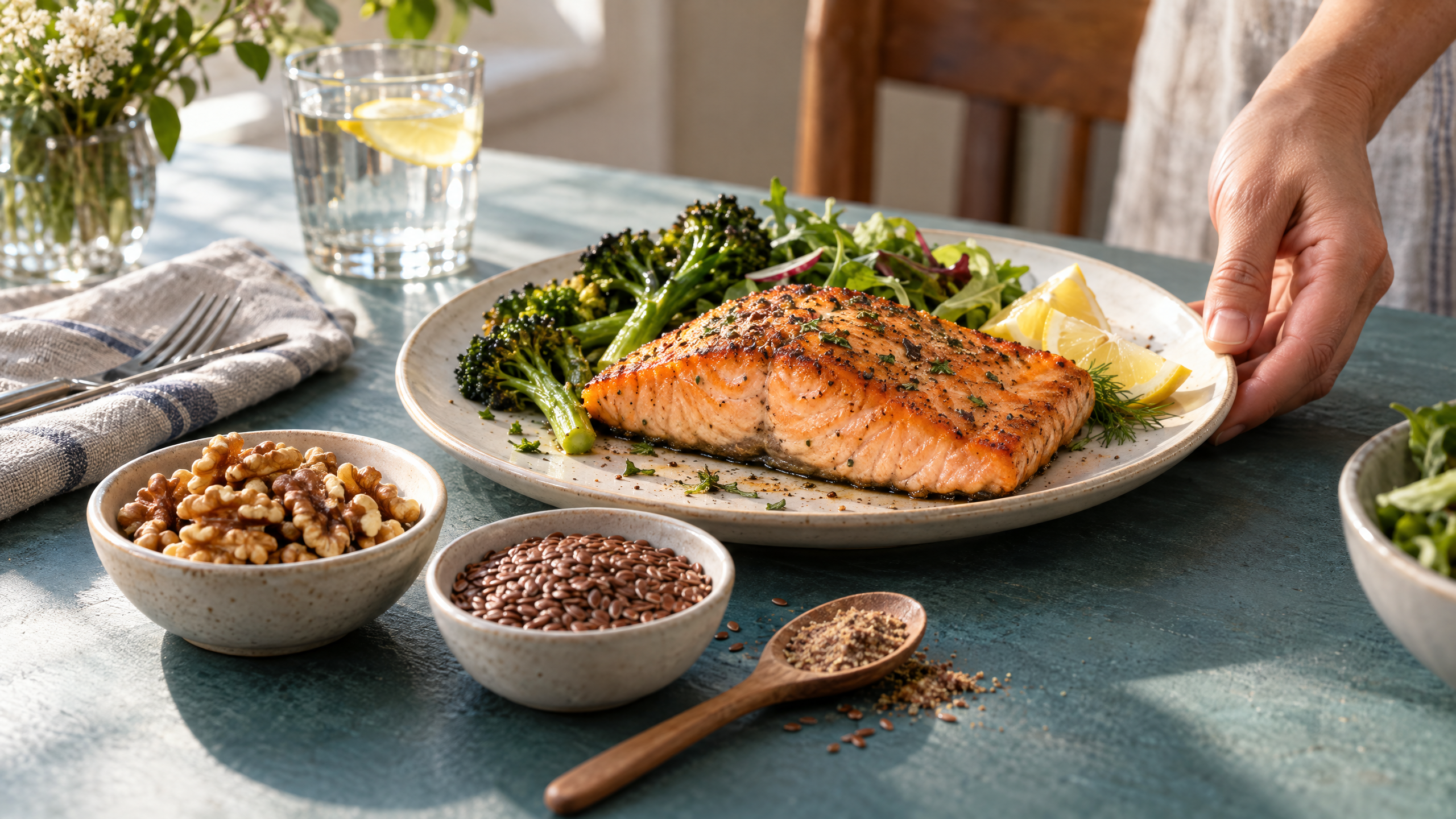
Fish, walnuts and flax all contribute omega-3s—but not the same forms. Learn how plant ALA differs from seafood EPA and DHA, and what that means for everyday food choices.
Salmon at dinner, walnuts on a salad and flax stirred into breakfast can all contribute omega-3 fats. But they do not provide the same mix of omega-3s. Knowing that difference makes food choices clearer without turning every meal into a nutrient calculation.[1]
The useful question is not which single food deserves a health halo. It is how different sources fit into an eating pattern you can enjoy and maintain.
One family of fats, three names worth knowing
Omega-3s are a family of polyunsaturated fats. Three forms appear often in nutrition advice: alpha-linolenic acid, or ALA; eicosapentaenoic acid, or EPA; and docosahexaenoic acid, or DHA.[1,2]
ALA is an essential fatty acid: your body cannot make it, so it must come from your diet. Walnuts, flaxseed, chia seeds and oils such as canola, soybean and flaxseed oil are sources. Fish and other seafood supply EPA and DHA; fatty fish such as salmon, sardines and herring are useful examples.[1]
Your body can turn some ALA into EPA and then DHA, but conversion is limited. That means an amount of ALA from walnuts or flax should not be treated as the same amount of EPA and DHA from fish. It does not make plant sources unimportant; ALA is itself an essential nutrient.[1,2]
Give plant sources a regular place
Plant omega-3 foods can fit into familiar meals rather than becoming a separate project. Try walnuts on oatmeal or a salad, stir ground flax into yogurt or porridge, or use canola oil in a homemade dressing. These are practical serving ideas, not a prescribed menu or a promise of a particular health outcome.
The aim is to recognize what the food contributes. Walnuts and flax supply ALA. They are not a direct serving-for-serving replacement for the EPA and DHA in seafood. You can value both sources without calling them interchangeable.[1,2]
There is also no need to assume that everyone has an omega-3 deficiency. NIH's Office of Dietary Supplements notes that most people in the United States get enough ALA, and omega-3 deficiency is very rare.[1]
If you eat fish, think about the type and the pattern
The American Heart Association recommends two servings of fish each week, particularly fatty fish. On its guidance page, a serving means 3 ounces cooked, or about three-quarters of a cup of flaked fish.[3]
That is a general food-pattern recommendation, not a treatment dose or a guarantee against heart disease. A salmon dinner or a sardine-based lunch can be one way to put it into practice, alongside the other foods you normally eat.
Fish choice matters for another reason: mercury levels differ. Salmon, sardines, herring and freshwater trout are among the FDA/EPA chart's lower-mercury “Best Choices.” People who might become pregnant, are pregnant or breastfeeding, and those feeding children should use the full FDA/EPA advice, which has its own portion sizes and frequency guidance. Do not substitute the AHA's adult serving definition for those instructions. For locally caught fish, check local advisories.[4]
What the heart-health evidence does—and does not—tell us
Regular fish and seafood intake is consistently associated with lower cardiovascular risk. But an association does not tell us that omega-3s alone caused the difference.[2,3]
NIH notes that studies of fish intake cannot easily separate the omega-3s from other nutrients in fish, the foods fish replaces, or other habits of people who eat it. The evidence supports considering seafood within a balanced eating pattern, not treating one nutrient as the whole explanation.[2]
For the same reason, research about eating fish is not automatically evidence that an over-the-counter capsule will deliver the same result. Food studies and supplement trials ask different questions. This article is a guide to food sources, not a claim that a supplement prevents or treats disease.
What if fish is not part of your diet?
ALA-rich plant foods still have a place. What they do not do is make the limited conversion to EPA and DHA disappear.[1,2]
Algal oil is a vegetarian source used in omega-3 supplements, but forms and amounts vary. Whether any supplement is appropriate is an individual question, especially with dietary restrictions, pregnancy or medicines that may interact. A qualified clinician or registered dietitian can help review those circumstances; fish avoidance is not, by itself, a reason to copy someone else's supplement dose.[1]
For everyday nutrition, start with the sources you actually eat. Recognize the different omega-3 forms, include appropriate foods regularly and keep the broader eating pattern in view. Fish, walnuts and flax can each have a role without needing to make identical claims about them.
References
1. NIH Office of Dietary Supplements: Omega-3 Fatty Acids — Consumer Fact Sheet
https://ods.od.nih.gov/factsheets/Omega3FattyAcids-Consumer/
2. NIH Office of Dietary Supplements: Omega-3 Fatty Acids — Health Professional Fact Sheet
https://ods.od.nih.gov/factsheets/Omega3FattyAcids-HealthProfessional/
3. American Heart Association: Fish and Omega-3 Fatty Acids
https://www.heart.org/en/healthy-living/healthy-eating/eat-smart/fats/fish-and-omega-3-fatty-acids
4. U.S. Food and Drug Administration / Environmental Protection Agency: Advice about Eating Fish
https://www.fda.gov/food/consumers/advice-about-eating-fish