
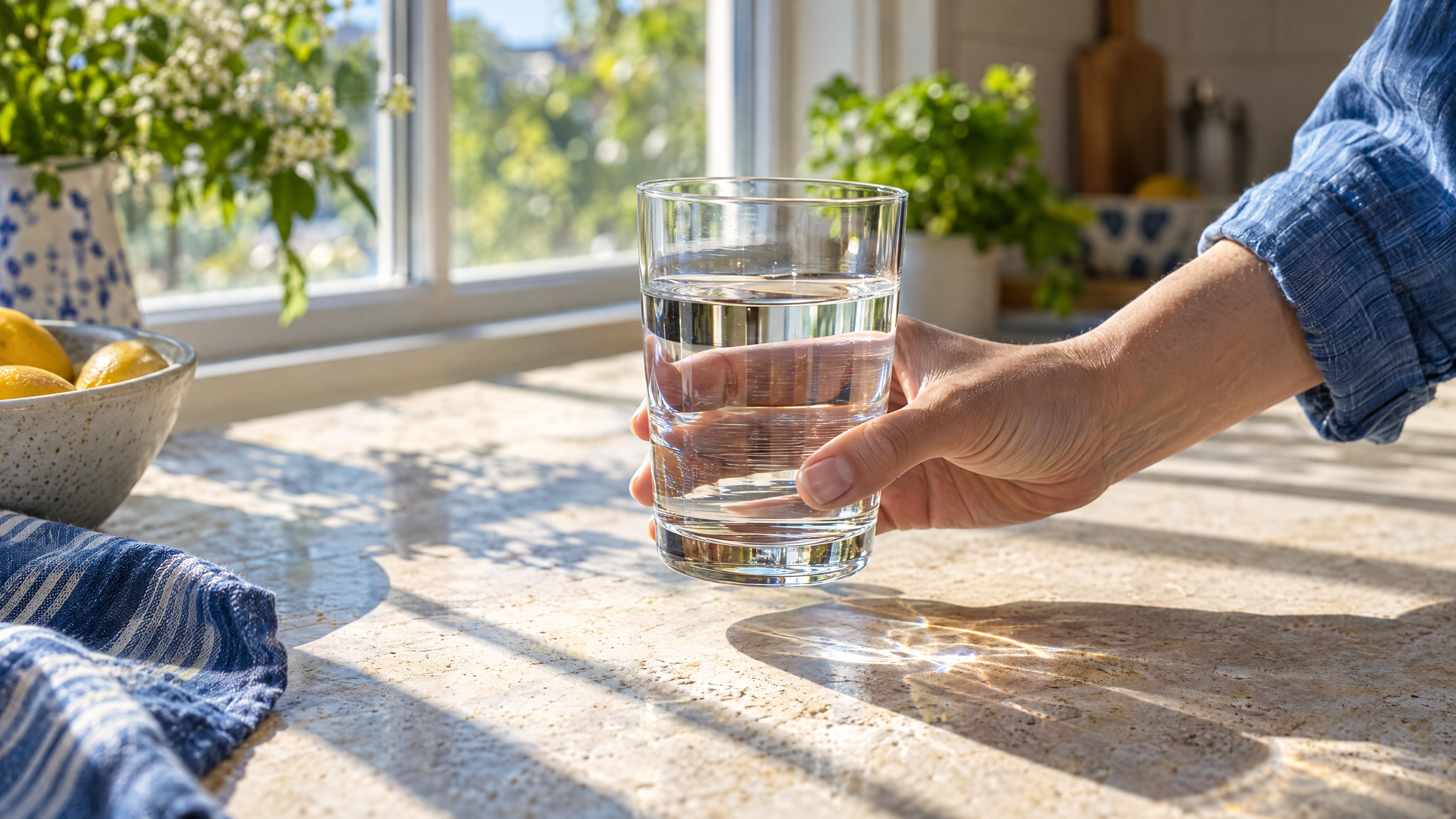
Hydration is more than counting glasses. Learn what total water intake means, why needs change, and when a generic fluid goal should give way to individual medical advice.
A simple glass of water can fit into a daily routine without becoming a one-size-fits-all target.
A familiar hydration rule sounds reassuring: drink a fixed number of glasses, and you are done. But a glass count leaves out much of the picture. Water in food, other drinks, the weather, activity, and individual health needs all matter.[1,2]
For everyday hydration, the useful question is not “Have I matched someone else’s bottle?” It is “Does my usual routine fit my circumstances—and am I following any personal medical advice?”
Total water is not just plain drinking water
The U.S. water reference values often quoted online—about 2.7 liters per day for adult women and 3.7 liters for adult men—refer to total water from all beverages and foods. They are adequate-intake reference levels, not instructions to drink that much plain water in addition to everything you already eat and drink.[1]
The National Academies panel explicitly declined to give a rule based on a universal number of glasses. Its reference levels cover the expected needs of healthy, sedentary people in temperate climates; activity and heat can change the picture.[1]
Foods with a high water content, such as many fruits and vegetables, contribute too. Other beverages also contribute fluid, although that does not make every drink nutritionally equivalent. Plain water is a straightforward choice, and replacing a sugary drink with it avoids the added sugar in that drink.[2]
The takeaway is not to calculate every bite’s water content. It is to avoid mistaking a total-water reference for a mandatory plain-water quota.
Your needs can change from one day to the next
The CDC identifies hot conditions, greater physical activity, fever, vomiting, and diarrhea as situations in which the body needs more water. Age, pregnancy, and breastfeeding also affect daily needs.[2]
That is why a cool day spent mostly indoors and a long, hot outdoor workday should not automatically be treated as identical. A routine that is convenient most days may need adjustment when conditions change.
Illness deserves particular care. Vomiting and diarrhea can involve losses of salts as well as fluid. A pharmacist or healthcare professional can advise whether an oral rehydration solution is appropriate; an everyday water goal is not a treatment plan for significant dehydration.[5]
Thirst is useful—but not everyone can rely on it alone
For most healthy people, thirst and normal drinking with meals help maintain hydration, according to the National Academies.[1] That is a useful everyday starting point, not a promise that thirst works equally well in every situation.
Some older adults have a reduced sense of thirst. Certain illnesses and medicines can also increase fluid losses, and someone who depends on others for drinks may need practical help getting them.[3,5] Regular access to fluids matters as well as knowing a guideline.
Dark urine, urinating less than usual, a dry mouth, and dizziness can be signs of dehydration.[3] They are reasons to pay attention, not proof that every headache or tired afternoon needs a larger bottle. Persistent or concerning symptoms deserve an assessment rather than a self-diagnosis.
More is not always better
Some people with advanced chronic kidney disease or kidney failure need to limit fluids because their bodies cannot remove the excess effectively. The National Kidney Foundation advises following the amount set by the healthcare team.[4] A generic hydration challenge should never override that plan.
Drinking very large amounts of water too quickly can also lower blood sodium to a dangerous level.[4] There is no benefit in treating hydration as a competition or forcing large volumes just to complete a target.
If you have been given a fluid restriction, ask how it should work during hot weather, exercise, or illness. Do not independently abandon the restriction—or assume that advice for healthy adults applies unchanged to you.
Make the routine practical, not rigid
For an otherwise healthy adult without a prescribed fluid limit, a few simple habits can make drinking easier: keep water accessible, serve it with meals, and carry a reusable bottle when that is convenient.[2] The bottle is a tool, not a test of how much you must finish.
Check what has changed before adding a new rule: Are you outside in the heat? More active than usual? Unwell? Have you been given individual guidance? Those questions are more informative than comparing your intake with a social-media target.
Seek prompt medical advice for symptoms such as dizziness on standing that does not go away, substantially reduced urination, or a fast heart rate with signs of dehydration. Confusion, unusual difficulty waking, or breathing difficulty can be emergencies.[5] Do not try to manage those situations by simply drinking more and waiting.
Everyday hydration is about enough fluid for the person and the situation—not a perfect number, a particular brand, or a promise that more water solves every symptom.
Educational information only; not individualized nutrition or medical advice.
References
1. National Academies: Report Sets Dietary Intake Levels for Water, Salt, and Potassium (water guidance)
https://www.nationalacademies.org/news/report-sets-dietary-intake-levels-for-water-salt-and-potassium-to-maintain-health-and-reduce-chronic-disease-risk
2. CDC: About Water and Healthier Drinks
https://www.cdc.gov/healthy-weight-growth/water-healthy-drinks/index.html
3. MedlinePlus: Dehydration
https://medlineplus.gov/dehydration.html
4. National Kidney Foundation: Healthy Hydration and Your Kidneys
https://www.kidney.org/kidney-topics/healthy-hydration-and-your-kidneys
5. NHS: Dehydration
https://www.nhs.uk/conditions/dehydration/